

How to Choose the Right Paper and Adhesive for Custom Sticky Notes?

How to Choose the Right Paper and Adhesive for Custom Sticky Notes?
When developing custom sticky notes, most brands focus first on size, shape, color, and printing.
But two factors have an even greater impact on the actual user experience:
Paper and adhesive.
The wrong paper can cause ink bleeding, poor writing performance, or excessive curling. The wrong adhesive can make notes fall off too easily—or stick so strongly that they become difficult to remove.
For brands, retailers, promotional companies, and stationery businesses, choosing the right combination of paper and adhesive is essential to creating a reliable product.
So, how should you choose?
1. Start with the Intended Use
Before choosing a paper or adhesive, ask one important question:
Where and how will the sticky note be used?
Different applications may require different specifications.
For example:
· Office sticky notes need comfortable writing and reliable everyday adhesion.
· Promotional sticky notes need good printing performance and consistent brand colors.
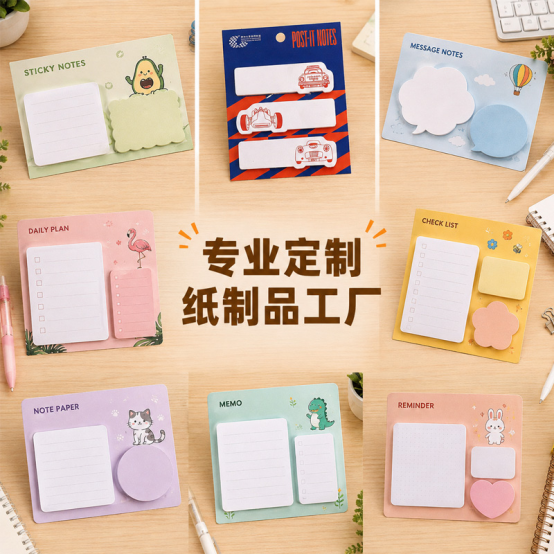
· Creative shaped sticky notes require paper that performs well during die-cutting.
· Premium stationery may require a better surface feel, appearance, and packaging.
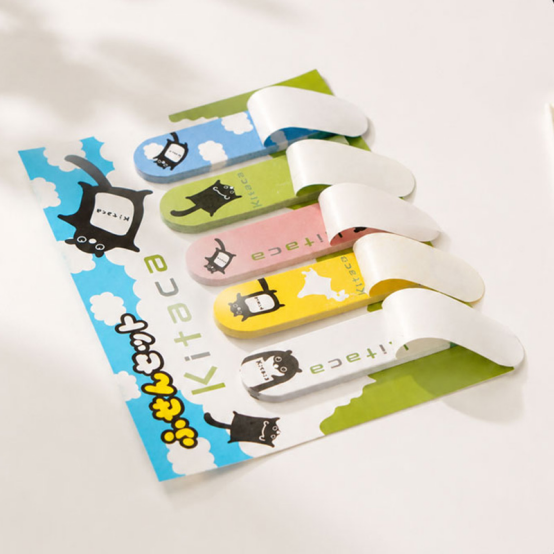
· Page markers and index notes may require different materials and adhesive performance from standard paper sticky notes.
There is no single specification that is perfect for every project. The right material should always match the application.
2. Choose the Right Paper Weight
Paper weight, usually expressed in GSM, affects the feel, opacity, flexibility, and cost of a sticky note.
If the paper is too thin, it may:
· Feel less substantial
· Show writing through the back
· Curl more easily
· Provide a less premium experience
However, simply choosing the thickest paper is not necessarily better.
Thicker paper can affect flexibility, pad thickness, adhesive performance, packaging dimensions, and overall cost.
The goal should be to find the right balance between:
Writing Experience + Product Function + Appearance + Cost
A professional manufacturer can recommend suitable paper specifications based on the product design and intended use.
3. Consider the Writing Experience
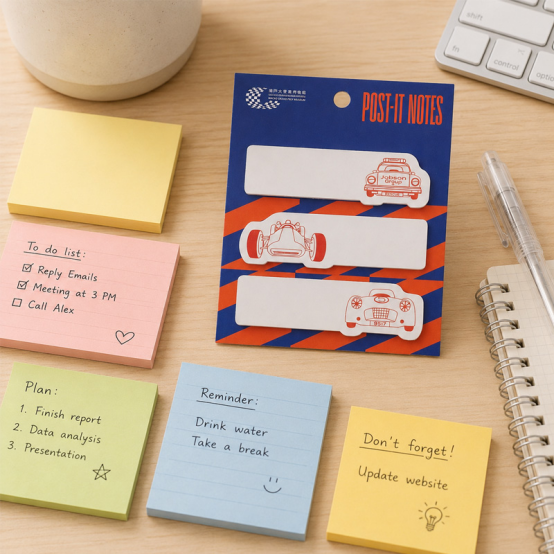
A sticky note is ultimately a writing product.
That means the paper surface needs to work well with commonly used writing tools.
Important factors include:
· Surface smoothness
· Ink absorption
· Drying performance
· Opacity
· Paper texture
For everyday office use, the paper should provide a comfortable writing experience with common pens and pencils.
If the paper absorbs ink too quickly, writing may appear less sharp or show through. If the surface is unsuitable, some inks may take longer to dry.
When developing a custom product, testing the actual paper is often more useful than selecting it based only on appearance.
4. Think About Paper Color
White is not the only option for custom sticky notes.
Brands can choose from:
· White
· Cream
· Pastel colors
· Bright colors
· Custom-colored paper
· Natural-looking paper
However, paper color affects printing.
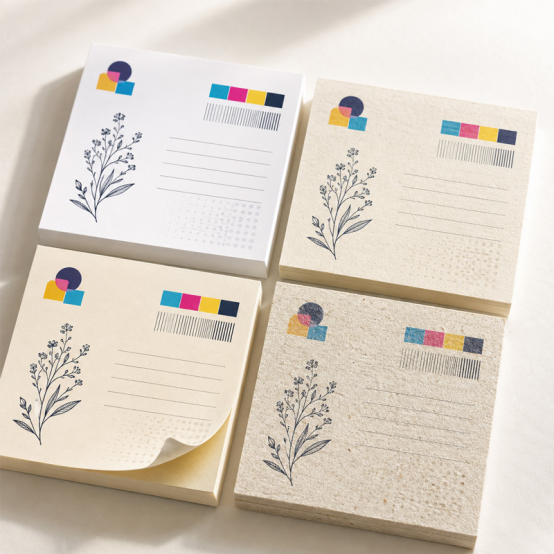
A design printed on white paper may look different when printed on yellow, pink, blue, or kraft-style paper.
For custom branding projects, the manufacturer should consider the relationship between:
Paper Color + Ink Color + Artwork
This is especially important when accurate brand colors are required.
5. Printing Requirements Should Influence Paper Selection
Not every paper performs the same during printing.
If your sticky note includes:
· A company logo
· Full-color artwork
· Detailed illustrations
· Fine text
· Writing lines
· Background patterns
you should consider how well the paper reproduces those elements.
For a simple one-color logo, the requirements may be relatively straightforward.
For detailed full-color designs, paper surface and color consistency become more important.
This is why paper selection should happen together with artwork evaluation—not as two separate decisions.
6. Adhesive Strength Is About Balance
One of the biggest misunderstandings about sticky notes is:
“The stronger the adhesive, the better the sticky note.”
That is not always true.
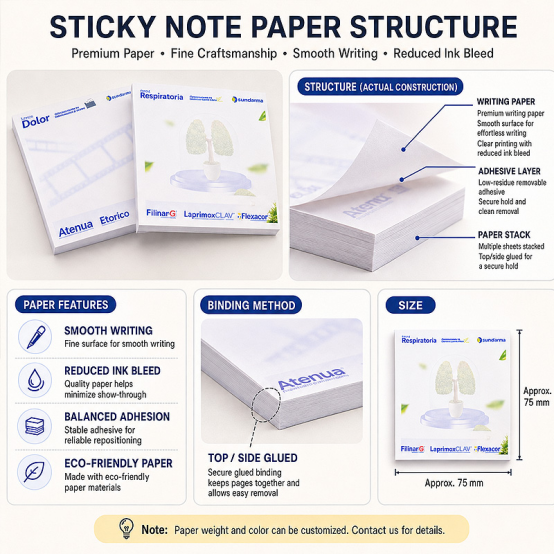
A good removable sticky note needs enough adhesion to stay in place during normal use while still being easy to remove.
If adhesion is too weak:
· Notes may fall off
· Corners may lift
· The product becomes unreliable
If adhesion is too strong:
· Notes may be difficult to remove
· Paper may curl or tear
· Residue may be more likely on some surfaces
· Repositioning becomes more difficult
The ideal adhesive depends on the intended application.
7. Consider the Surface Where the Note Will Be Used
Adhesive performance can change depending on the surface.
Sticky notes may be applied to:
· Paper
· Notebooks
· Desks
· Glass
· Computer monitors
· Walls
· Packaging
A note that performs well on smooth paper may behave differently on a textured, dusty, curved, or coated surface.
This is why brands should communicate the intended application to the manufacturer before mass production.
For special applications, actual surface testing may be necessary.

8. Pay Attention to Adhesive Coating Consistency
The adhesive itself is only part of the equation.
How evenly the adhesive is applied also matters.
Poor coating consistency can cause:
· Uneven adhesion
· Lifted corners
· Different performance between sheets
· Inconsistent quality across pads
For large custom orders, stable production control becomes particularly important.
A professional sticky note manufacturer should control the adhesive application so that the finished products perform consistently across the production batch.
9. Test Paper and Adhesive Together
Paper and adhesive should never be evaluated completely independently.
Changing the paper can affect:
· Flexibility
· Curling behavior
· Peeling performance
· Adhesive interaction
Likewise, changing the adhesive can change how the finished note behaves.
That is why sampling is important.
Before mass production, brands can evaluate:
· Writing performance
· Printing quality
· Adhesion
· Removability
· Curling
· Overall appearance
For customized products, a physical sample can reveal issues that specifications on a quotation sheet cannot.

10. Don't Choose Materials Based on Price Alone
Two sticky notes may look almost identical in a product photo but perform very differently in real use.
A lower quotation may involve differences in:
· Paper quality
· Paper weight
· Adhesive performance
· Printing standards
· Production consistency
· Quality inspection
This does not mean the most expensive option is always the best.
Instead, buyers should compare what is actually included in each quotation.
Ask your supplier:
What paper is being used?
What is the paper weight?
What adhesive is recommended for my application?
Can I test a sample before production?
How do you control consistency during mass production?
These questions are often more useful than comparing unit prices alone.
How to Find the Right Combination
A successful custom sticky note requires the right balance of:
Paper Quality + Writing Performance + Adhesion + Printing + Cost
For a promotional project, printing and budget may be the priorities.
For a premium stationery brand, paper feel and writing experience may matter more.
For office products, reliable adhesion and everyday usability may be the most important factors.
The best solution depends on what you want the product to achieve.
Final Thoughts
Paper and adhesive may seem like basic components, but they determine much of the quality behind a custom sticky note.
Good material selection helps create a product that:
· Writes comfortably
· Looks professional
· Sticks reliably
· Removes easily
· Represents the brand well
Before placing a bulk order, don't simply ask:
“How much does this sticky note cost?”
A better question is:
“Which paper and adhesive combination is right for my product?”
Choosing the right materials from the beginning can help reduce production problems, improve the customer experience, and create a custom sticky note that people actually enjoy using.