How to Customize a Notepad for Your Brand: A Complete Guide
How to Customize a Notepad for Your Brand: A Complete Guide
Custom notepads may look simple, but for brands, they can be much more than everyday stationery.
A well-designed notepad can be used as a promotional product, corporate gift, retail item, office supply, event giveaway, or part of a premium stationery set. Because it is practical and frequently used, it also gives your brand repeated visibility.
However, creating a good custom notepad involves more than simply printing a logo on paper.
From size and paper selection to printing, binding, packaging, and quality control, every detail can affect the final product.
So, how should brands customize a notepad?
Here is a complete guide.
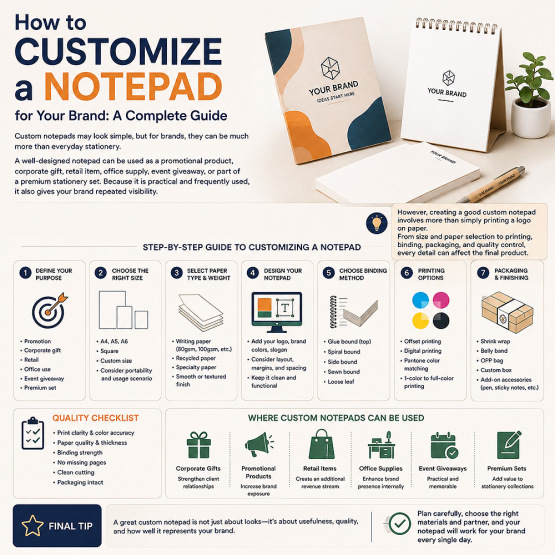
1. Start with the Purpose of the Notepad
Before discussing materials or printing, determine how the product will be used.
Ask yourself:
Who will use it?
Where will they use it?
What do you want the product to achieve?
For example, a notepad designed for a trade show may prioritize affordability and brand visibility, while a notepad sold by a premium stationery brand may focus more on paper quality, design, and packaging.
Common applications include:
· Corporate gifts
· Office stationery
· Promotional giveaways
· School supplies
· Retail stationery
· Conferences and events
· Holiday gift sets
· Brand merchandise
The intended use should guide almost every decision that follows.
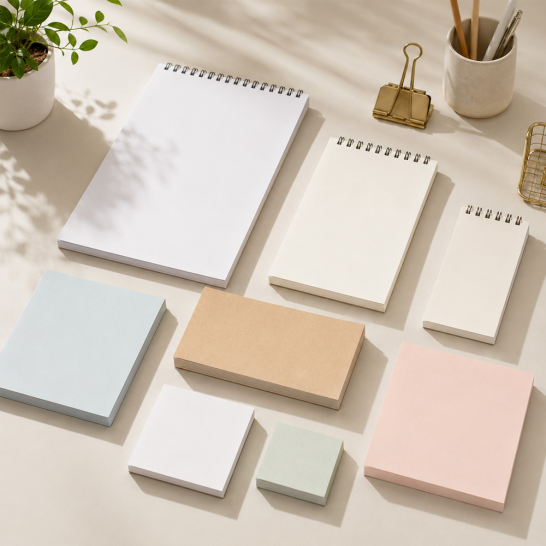
2. Choose the Right Size
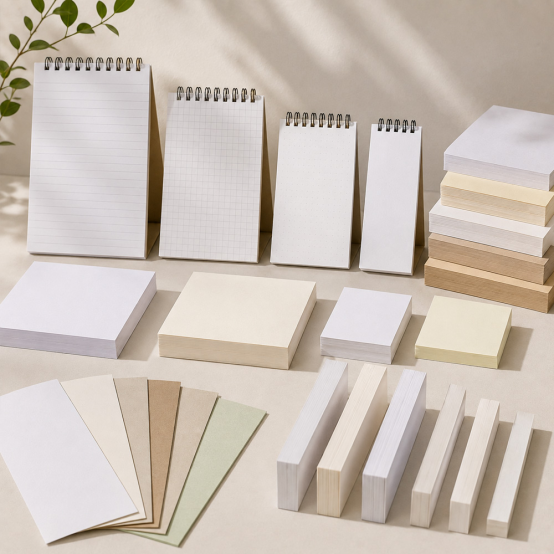
Size is one of the first specifications to confirm.
Common notepad sizes include:
· A4
· A5
· A6
· Custom sizes
Smaller notepads are portable and suitable for quick notes, while larger formats provide more writing space for meetings, planning, and office use.
Custom sizes can also help a product stand out, especially when the dimensions are designed around a particular brand concept or packaging structure.
However, unusual sizes may affect material usage, production efficiency, packaging, and cost.
For most projects, the best size is not necessarily the largest or most creative—it is the one that best matches the user's needs.
3. Select the Right Paper
Paper has a direct impact on writing experience and perceived quality.
When choosing paper, consider:
Paper Weight (GSM)
Heavier paper generally feels more substantial, but it can also increase product thickness and cost.
Surface Smoothness
The paper should provide a comfortable writing experience.
Opacity
Higher opacity can help reduce show-through from the opposite side.
Paper Color
White, cream, natural, and custom-colored papers can create very different visual styles.
Printing Performance
The paper should work well with the intended artwork and printing method.
For brands developing environmentally focused products, responsibly sourced or recycled paper may also be considered depending on the project's requirements.
The important point is to select paper based on function, appearance, printing requirements, and budget together.
4. Decide How Many Sheets You Need
Sheet count affects both functionality and cost.
A promotional notepad designed for an event may require fewer sheets, while a retail or office product may need more.
Brands should consider:
· Expected usage period
· Product positioning
· Total thickness
· Target price
· Packaging requirements
More sheets do not automatically mean a better product.
A carefully designed 50-sheet notepad may provide more value than a poorly designed 100-sheet version.
The specification should match the intended use.
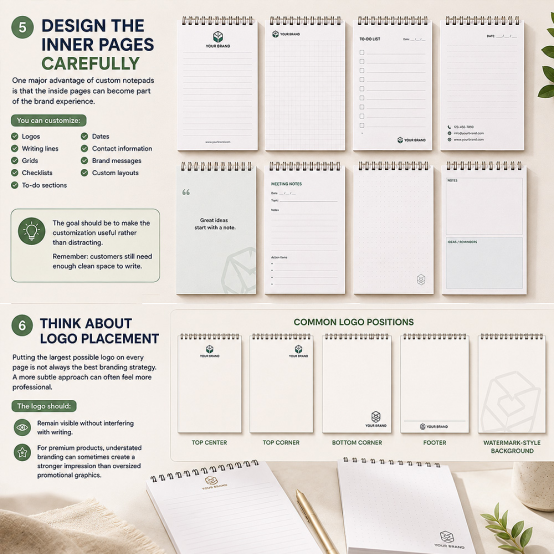
5. Design the Inner Pages Carefully
One major advantage of custom notepads is that the inside pages can become part of the brand experience.
Instead of completely blank sheets, brands can customize:
· Logos
· Writing lines
· Grids
· Checklists
· To-do sections
· Dates
· Contact information
· Brand messages
· Custom layouts
For example, a real estate company could create a notepad specifically for property viewing notes.
A fitness brand could create a daily planning format.
A corporate brand could use subtle logo placement and brand colors.
The goal should be to make the customization useful rather than distracting.
Remember: customers still need enough clean space to write.
6. Think About Logo Placement
Putting the largest possible logo on every page is not always the best branding strategy.
A more subtle approach can often feel more professional.
Common logo positions include:
· Top center
· Top corner
· Bottom corner
· Footer
· Watermark-style background
The logo should remain visible without interfering with writing.
For premium products, understated branding can sometimes create a stronger impression than oversized promotional graphics.
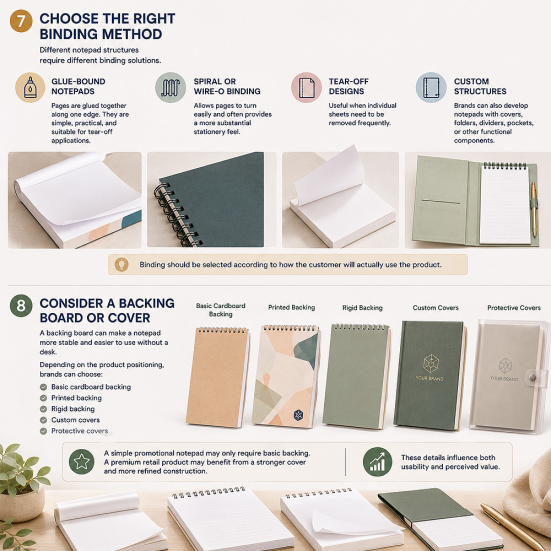
7. Choose the Right Binding Method
Different notepad structures require different binding solutions.
Glue-Bound Notepads
Pages are glued together along one edge.
They are simple, practical, and suitable for tear-off applications.
Spiral or Wire-O Binding
Allows pages to turn easily and often provides a more substantial stationery feel.
Tear-Off Designs
Useful when individual sheets need to be removed frequently.
Custom Structures
Brands can also develop notepads with covers, folders, dividers, pockets, or other functional components.
Binding should be selected according to how the customer will actually use the product.
8. Consider a Backing Board or Cover
A backing board can make a notepad more stable and easier to use without a desk.
Depending on the product positioning, brands can choose:
· Basic cardboard backing
· Printed backing
· Rigid backing
· Custom covers
· Protective covers
A simple promotional notepad may only require basic backing.
A premium retail product may benefit from a stronger cover and more refined construction.
These details influence both usability and perceived value.
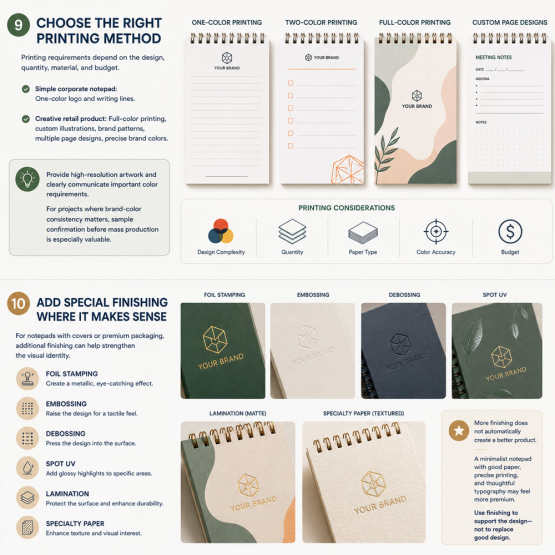
9. Choose the Right Printing Method
Printing requirements depend on the design, quantity, material, and budget.
A simple corporate notepad may only need a one-color logo and writing lines.
A creative retail product may require:
· Full-color printing
· Custom illustrations
· Brand patterns
· Multiple page designs
· Precise brand colors
Brands should provide high-resolution artwork and clearly communicate important color requirements.
For projects where brand-color consistency matters, sample confirmation before mass production is especially valuable.
10. Add Special Finishing Where It Makes Sense
For notepads with covers or premium packaging, additional finishing can help strengthen the visual identity.
Options may include:
· Foil stamping
· Embossing
· Debossing
· Spot UV
· Lamination
· Specialty paper
However, more finishing does not automatically create a better product.
A minimalist notepad with good paper, precise printing, and thoughtful typography may feel more premium than a product using too many decorative processes.
Use finishing to support the design—not to replace good design.
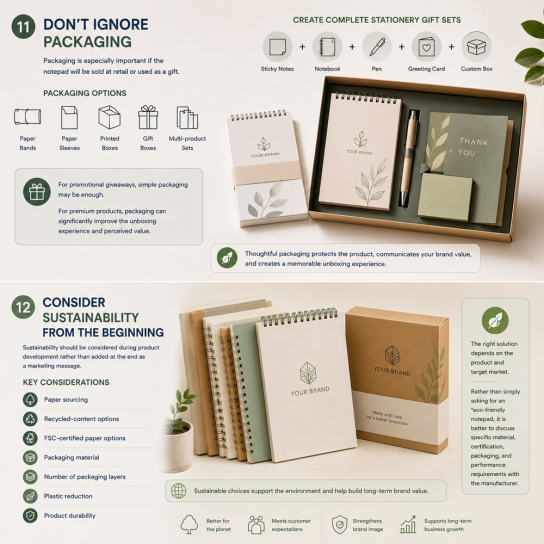
11. Don't Ignore Packaging
Packaging is especially important if the notepad will be sold at retail or used as a gift.
Depending on the project, options can include:
· Paper bands
· Paper sleeves
· Printed boxes
· Gift boxes
· Multi-product stationery sets
For promotional giveaways, simple packaging may be enough.
For premium products, packaging can significantly improve the unboxing experience and perceived value.
Brands can also combine a notepad with:
Sticky Notes + Notebook + Pen + Greeting Card + Custom Box
to create a complete branded stationery or corporate gift set.
12. Consider Sustainability from the Beginning
Sustainability should be considered during product development rather than added at the end as a marketing message.
Brands can evaluate:
· Paper sourcing
· Recycled-content options
· FSC-certified paper options
· Packaging material
· Number of packaging layers
· Plastic reduction
· Product durability
The right solution depends on the product and target market.
Rather than simply asking for an "eco-friendly notepad," it is better to discuss specific material, certification, packaging, and performance requirements with the manufacturer.
13. Always Make a Sample Before Mass Production
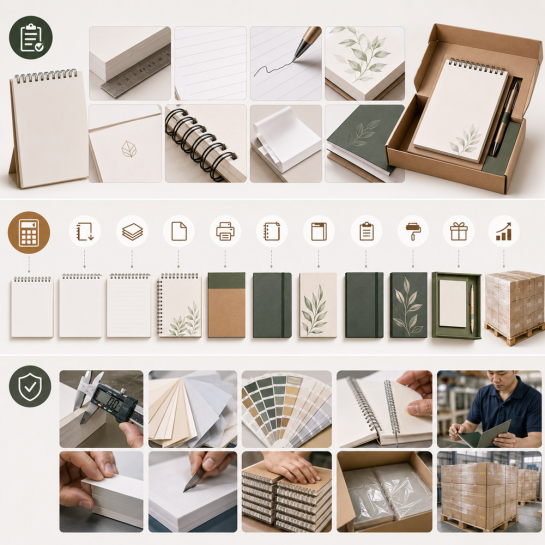
For a custom project, a physical sample can help confirm details that are difficult to judge from a digital design.
Check:
· Actual size
· Paper feel
· Writing experience
· Printing colors
· Logo position
· Binding
· Page turning or tear-off performance
· Cover quality
· Packaging
This stage is particularly important for products involving custom structures, special materials, or premium finishing.
A small adjustment during sampling can prevent a much larger problem during mass production.
14. Understand What Determines the Price
The price of a custom notepad is influenced by many variables.
These can include:
· Size
· Paper type
· GSM
· Sheet count
· Printing
· Binding
· Cover
· Backing board
· Special finishing
· Packaging
· Order quantity
This is why comparing quotations based only on the final unit price can be misleading.
Two suppliers may quote very different prices because the underlying specifications are not actually the same.
When requesting quotations, provide as much information as possible so manufacturers can offer an accurate comparison.
15. Quality Control Matters in Mass Production
A good sample is only the beginning.
During mass production, manufacturers need to maintain consistency across the entire order.
Important quality points include:
· Correct dimensions
· Paper consistency
· Printing accuracy
· Color consistency
· Sheet count
· Binding strength
· Cutting accuracy
· Packaging condition
For large orders, stable production control is just as important as product design.
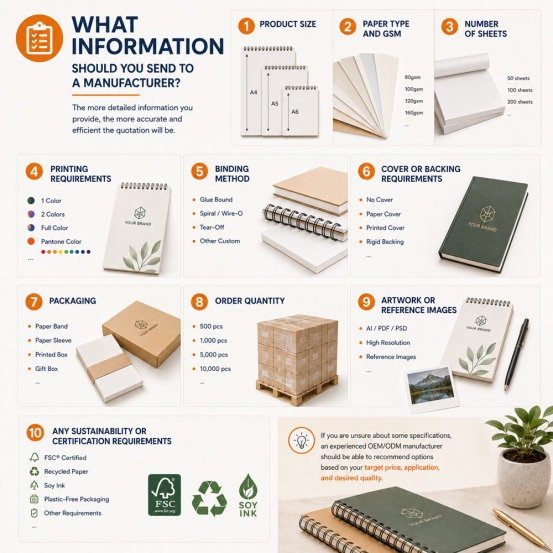
What Information Should You Send to a Manufacturer?
To receive a more accurate quotation, prepare the following information:
1. Product size
2. Paper type and GSM
3. Number of sheets
4. Printing requirements
5. Binding method
6. Cover or backing requirements
7. Packaging
8. Order quantity
9. Artwork or reference images
10. Any sustainability or certification requirements
If you are unsure about some specifications, an experienced OEM/ODM manufacturer should be able to recommend options based on your target price, application, and desired quality.
Final Thoughts
A successful custom notepad is not simply:
Paper + Logo + Glue.
It is the result of:
Material Selection + Functional Design + Printing + Binding + Packaging + Quality Control
For brands, even a simple notepad can become an effective product when every detail is designed around the customer.
Whether you are developing promotional stationery, a retail collection, corporate gifts, or a complete paper gift set, start with one question:
“Why would our customers want to use this notepad every day?”
When functionality and brand identity work together, a simple paper product can become something customers use, keep, and remember.