5 Mistakes to Avoid When Ordering Custom Notebooks
5 Mistakes to Avoid When Ordering Custom Notebooks
Custom notebooks are more than writing tools. They can represent your brand, support marketing campaigns, strengthen customer relationships, and create a memorable user experience.
However, small mistakes during the customization process can lead to higher costs, production delays, or products that do not meet expectations. Before placing your next order, make sure you avoid these five common mistakes.
1. Choosing the Wrong Paper
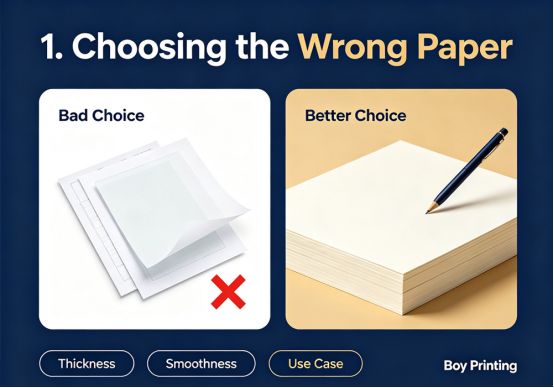
Paper quality directly affects how a notebook feels and performs.
If the paper is too thin, ink may show through to the other side. If it is too rough, writing may feel uncomfortable. Choosing the wrong paper can also affect the notebook’s appearance and overall quality.
Before ordering, consider:
· Paper thickness and weight
· Smoothness and writing comfort
· Ink absorption
· Single-sided or double-sided printing
· Writing, drawing, journaling, or office use
For example, a notebook designed for daily writing may require different paper from a sketchbook or premium corporate journal.
Tip: Always request a paper sample or pre-production sample before confirming a large order.
2. Ignoring the Binding Method
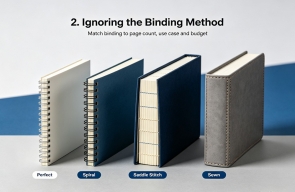
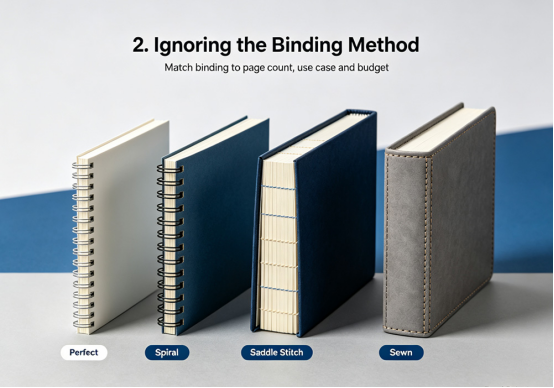
Notebook binding is not only about appearance. It also affects how the notebook opens, turns, and feels in daily use.
Different binding methods offer different benefits:
· Perfect Binding: Clean and professional, suitable for notebooks and journals.
· Spiral Binding: Flexible and convenient, ideal for planners and everyday writing.
· Hardcover Binding: Durable and premium, suitable for corporate gifts and high-end notebooks.
· Saddle Stitching: Lightweight and economical, suitable for thin notebooks.
· Sewn Binding: Strong and durable, often used for premium notebooks.
Choosing a binding method without considering the notebook’s page count, usage, and target price may result in an unsuitable product.
Tip: Select the binding together with the paper, cover material, page count, and intended user experience.
3. Not Confirming the Artwork and Specifications
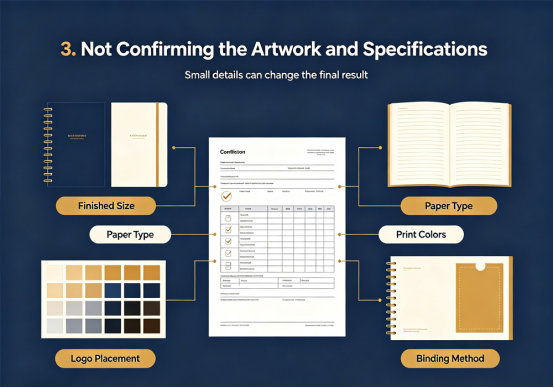
Unclear artwork or incomplete specifications can cause production problems.
Before production begins, confirm every important detail, including:
· Finished notebook size
· Page count
· Paper type and thickness
· Cover material
· Printing colors
· Logo position
· Binding method
· Finishing options
· Packaging requirements
It is also important to check whether the artwork is suitable for printing. Low-resolution images, incorrect colors, missing fonts, or incorrect file sizes may affect the final result.
Tip: Use professional print-ready artwork and request a digital proof or physical sample for approval before mass production.
4. Choosing Finishing Options Without a Clear Purpose
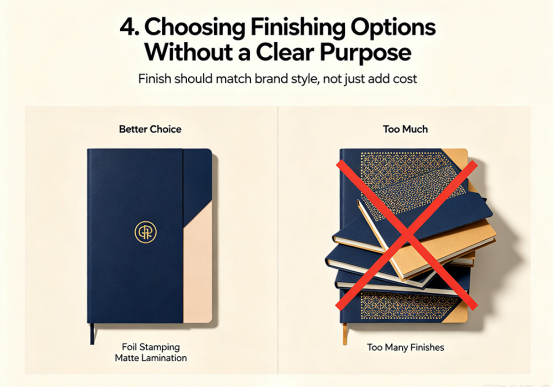
Finishing techniques can make a notebook look more attractive and premium, but using too many techniques may increase cost and create an unnecessarily complicated design.
Common finishing options include:
· Foil stamping
· Embossing and debossing
· Spot UV
· Matte or gloss lamination
· Soft-touch lamination
· Die-cutting
· Elastic bands
· Ribbon bookmarks
· Custom pockets
The right finishing should match your brand style and product positioning. For example, foil stamping may work well for a luxury notebook, while a simple matte cover may be more suitable for a minimalist office notebook.
Tip: Choose finishing based on your brand image, target customers, budget, and intended use—not simply because more techniques look more impressive.
5. Focusing Only on Unit Price
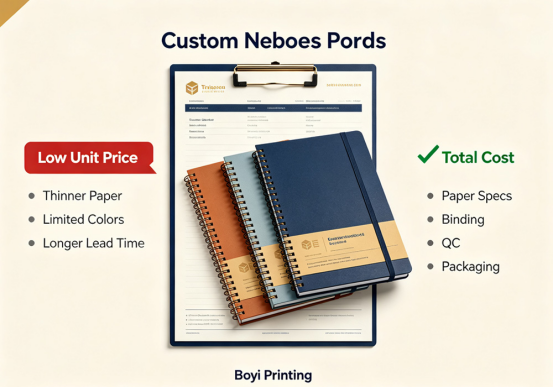
Price is important, but the lowest quotation does not always represent the lowest total cost.
A lower unit price may come with limitations such as:
· Lower paper quality
· Fewer customization options
· Limited color accuracy
· Weaker binding
· Higher minimum order quantity
· Longer production time
· Additional packaging or shipping fees
When comparing suppliers, look at the complete quotation and confirm what is included. You should also review the supplier’s production capabilities, quality control process, communication efficiency, and experience with similar products.
Tip: Compare product specifications and service scope—not just the final unit price.
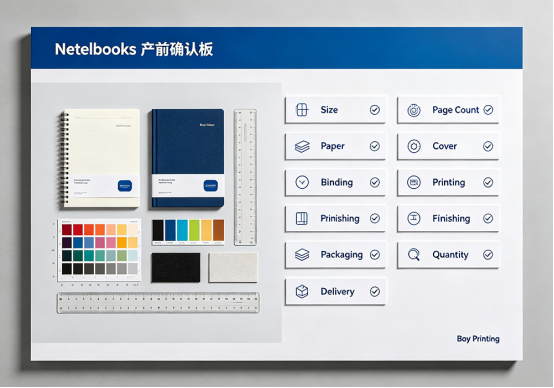
What Should You Confirm Before Ordering?
A clear specification sheet can help reduce misunderstandings and production risks.
Item | Details to Confirm |
Size | A4, A5, A6, or custom size |
Page Count | Total pages and page layout |
Paper | Type, thickness, color, and writing performance |
Cover | Paper, PU, fabric, cardboard, or other material |
Binding | Perfect, spiral, sewn, hardcover, or saddle stitching |
Printing | Cover printing, inner pages, and color requirements |
Finishing | Foil stamping, embossing, lamination, and accessories |
Packaging | Individual packaging, gift box, carton, and shipping marks |
Quantity | Sample quantity and mass production quantity |
Delivery | Sample lead time and mass production lead time |
Final Thoughts
Ordering custom notebooks successfully requires more than choosing a size and adding a logo. Paper quality, binding, artwork, finishing, and supplier selection all influence the final product.
By avoiding these five mistakes, you can reduce unnecessary costs, improve production efficiency, and create notebooks that better represent your brand.
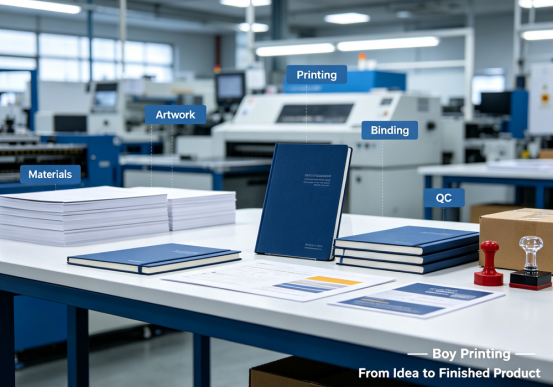
At Boyi, we support custom notebook projects from material selection and artwork confirmation to printing, binding, quality inspection, and final delivery. Whether you need promotional notebooks, corporate journals, planners, or premium gift notebooks, we can help turn your ideas into finished paper products.
Planning your next custom notebook project? Contact us to discuss your size, materials, design, and customization requirements.